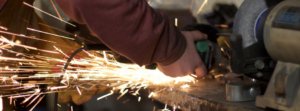

Picture a factory. It clanks. It hisses. It smells of grease and ozone. A conveyor belt moves an endless line of widgets past a man in a grey coat holding a clipboard. He measures a bolt, ticks a box, and the line rolls on.
This is the image that haunts ISO 9001. It is the ghost of the standard’s past – a rigid, rust-covered relic of the manufacturing age.
Now, look at your business. Maybe you run a digital marketing agency in Lancaster, an IT company in Manchester, or a logistics firm in Leeds. It is silent, save for the hum of laptops and the ping of Slack notifications. There is no grease. There are no bolts.
So, when someone suggests you need a Quality Management System (QMS), you laugh. You think: “We don’t make widgets. We sell ideas. We sell code. We sell expertise. You can’t measure a creative brief with a set of callipers.”
You are right. You can’t measure ideas with callipers. But make no mistake: You are running a factory. It is just an invisible one.
And right now your invisible factory is leaking.
The Invisible Assembly Line
In a service business, the “raw material” isn’t steel; it is a client’s half-baked request. The “machine” isn’t a press; it is your team’s brainpower. The “product” isn’t a toaster; it is a solution.
But because you can’t see the assembly line, you ignore the bottlenecks.
- The sales team promises a feature the dev team hasn’t built yet. That’s a supply chain failure.
- The account manager stores the client’s feedback in their head, not the CRM. That’s a data silo.
- The junior designer uses the wrong logo file because the “Final_Final_V3” folder is a mess. That’s a manufacturing defect.
ISO 9001 isn’t about turning your creative team into robots. It is about building a trellis so the vine can grow. It is about defining the “Service Sprint” – the repeatable rhythm that turns chaos into consistency.
Here is how you swap the clipboard for the dashboard and apply ISO 9001 to the modern service economy.
Lens 1: Process is Not a Prison (Service Delivery)
In manufacturing, variance is the enemy. In services, variance is the value prop. No two consulting gigs are the same.
The mistake most accredited auditors make is trying to force-feed you a “Standard Operating Procedure” (SOP) for everything. They want a script.
We don’t want a script. We want a playbook.
Think of a jazz band. They improvise. They riff. But they are all playing in the same key, at the same tempo, using the same chord progression. If the drummer decides to play in 7/4 time while the bassist is in 4/4, you don’t get jazz. You get noise.
The ISO 9001 Fix:
Don’t document the art. Document the frame.
- Don’t write a procedure on “How to design a website.”
- Do write a procedure on “How we approve the design before the client sees it.”
- Do standardise the input (the creative brief) and the output (the sign-off).
What happens in the middle is your magic. The standard just ensures the magic arrives on time.
Lens 2: The “Bus Factor” (Knowledge Management)
In a factory, if a machine breaks, you buy a spare part. In a service business, if your Lead Developer walks under a bus (or, more likely, gets poached by a bank), your “machine” is gone.
Service businesses run on tribal knowledge. “Ask Dave, he knows how the API works.” “Ask Sarah, she remembers the client’s login.”
This is a single point of failure. It is a cliff edge.
The ISO 9001 Fix:
Clause 7.1.6 (Organisational Knowledge) is your safety net. It demands you extract the wisdom from Dave’s head and put it into the system.
- It’s not about writing a 50-page manual.
- It’s about recording the Zoom training session.
- It’s about a searchable Wiki.
- It’s about ensuring that when Dave leaves, the business doesn’t leave with him.
You are building a “Corporate Brain” that survives the turnover of its cells.
Lens 3: The Digital Shop Floor (Remote Operations)
The biggest lie in modern business is “We are a remote-first company.” Usually, this translates to: “We are a chaotic collection of freelancers on WhatsApp.”
If your “shop floor” is digital, your ISO audit must be digital. An auditor looking for a fire-proof filing cabinet in 2026 is looking for a dinosaur.
The ISO 9001 Fix:
- The Audit Trail: We don’t check signatures on paper. We check the “Approved by” timestamp in Asana.
- Non-Conformance: A “defect” isn’t a bent widget. It’s a ticket in Jira that has been open for 60 days with no updates.
- Customer Communication: We don’t review letters. We review the response time metrics in your ZenDesk or Intercom.
If your process relies on a sticky note on a monitor, and that monitor is in a spare bedroom in Leeds, you don’t have a process. You have a prayer. ISO 9001 digitises the discipline.
The Unaccredited Edge: Auditing the Flow, Not the Font
Here is the truth. If you hire a traditional, UKAS-accredited body, they will likely send an auditor a set collection of rules and years in manufacturing. They will ask you where your “Calibration Records” are. They will look confused when you explain that you don’t calibrate software.
They will try to fix the plane while it’s flying by bolting heavy iron plates to the wings.
As an independent body, we understand that for a service business, agility is the asset.
We don’t audit for the sake of the certificate. We audit to remove friction.
- We strip out the “mandatory” logs that add no value.
- We focus on Customer Satisfaction (Clause 9.1.2), because in services, your reputation is your only currency.
- We accept that a “Management Review” can be a Slack channel, not a boardroom meeting with biscuits.
The Bottom Line
You can keep treating your service delivery like an art project – messy, unpredictable, and reliant on heroism. You can keep jumping off cliffs and trying to assemble the plane on the way down, dodging the screeching monkeys of missed deadlines and angry clients.
Or, you can recognise that service is a science.
ISO 9001 is the operating system for that science. It doesn’t kill the creativity; it builds the stage for it.
Stop fearing the clipboard. Start designing the flow. Ask for help: